Most nonprofits in the US pay between $500 and $2,500 per month for outsourced social media management. Small organisations with one or two channels usually land between $750 and $1,500. Larger organisations that need video, paid ads and campaign work pay $2,500 to $7,500+.
That is the short answer. The longer answer is more useful, because the price you are quoted has less to do with your organisation and more to do with how many hours of work the provider has priced in — and almost nobody tells you that part.
This article covers what each budget level actually buys, how freelancer and agency pricing differ, what makes a quote go up, what a small nonprofit should realistically budget, and the questions I would ask before signing anything.
Where these numbers come from
I want to be clear about what is measured and what is judgement.
What is well documented: general social media management pricing across the market, and US nonprofit salary data. Both are cited below.
What is not well documented: there is no reliable, published, market-wide "average price nonprofits pay for social media management." I looked. Anyone quoting you a precise sector average has almost certainly made it up or generalised from a handful of agency pages.
What is my own view: the budget percentages, the cost-per-content-piece method, and the hire-versus-outsource comparison are my analysis, based on published salary data plus what I see in quotes and scopes when nonprofits show them to me. I have flagged these clearly in the text.
Quick pricing table: what each budget buys in 2026
| Monthly budget | Typically provided by | Realistic scope | Best fit |
|---|---|---|---|
| Under $500 | Junior or offshore freelancer, or a very limited package | 8–12 posts/month, 1–2 channels, basic graphics, scheduling. Usually no video, no strategy, little community management | Organisations under ~$300K budget that need anything published |
| $500 – $1,000 | Experienced freelancer | 12–16 posts/month, 2 channels, on-brand graphics, captions, 2–4 short videos, basic monthly report | Small nonprofits, $500K–$1.5M, one comms person |
| $1,000 – $1,500 | Specialist freelancer or very small studio | 16–24 posts/month, 2–3 channels, 4–8 Reels, content calendar planned ahead, community management, campaign or event support, proper reporting | Most small and mid-size nonprofits, $750K–$4M. This is where the majority of good-value work sits |
| $1,500 – $2,500 | Boutique agency or senior specialist | 24–30 posts/month, 3+ channels, 8–12 videos, strategy, quarterly reviews, some paid ads management | $2M–$10M organisations with real campaign calendars |
| $2,500 – $7,500 | Full-service agency | Multi-channel programme, dedicated account manager, original photo/video production, paid media, analytics | $10M+ organisations, or those running major campaigns |
| $7,500+ | Large agency | Full brand and digital programme | National organisations |
← Scroll table sideways to see all columns
How to read this table: the ranges reflect published pricing across the wider social media management market in 2026, where general packages commonly run from around $500 to $5,000+ per month depending on scope. Nonprofit-specialist providers cluster at the lower end of that band. For example, Socialistics, a US agency that works only with nonprofits, publishes retainers starting at $1,500 per month and positions that explicitly against traditional agencies charging $5,000–$10,000.
The nonprofit-specific breakdown of scope in the middle column is my own, based on what I see in scopes and what the work actually takes.
What you are really buying: hours, not posts
Here is the thing that makes every quote easier to understand.
Social media management is priced on time. A provider works out roughly how many hours your account will take each month, applies their rate, and gives you a number. Everything else — the package name, the tier, the deliverable list — is just a way of describing those hours.
A rough guide to where the hours go on a small nonprofit account:
| Task | Hours per month |
|---|---|
| Planning and content calendar | 3–5 |
| Graphic design | 5–8 |
| Short-form video editing | 6–12 |
| Writing captions and copy | 3–5 |
| Scheduling and publishing | 2–3 |
| Community management (comments, DMs) | 3–6 |
| Reporting and a monthly call | 2–3 |
| Total | 24–42 hours |
This is my own estimate from doing the work, not published data.
So a $1,200 retainer covering roughly 30 hours works out to about $40 an hour. A $500 retainer for the same scope would be about $17 an hour — which means either the scope is much smaller than it sounds, or the work is being rushed.
Why this matters when you compare quotes: if two providers quote $900 and $1,800 for what looks like the same list of deliverables, one of them has priced fewer hours. Ask which. Usually the difference is video, community management, or how far ahead the calendar is planned.
What actually makes the price go up
In rough order of impact:
1. Short-form video. This is the single biggest cost driver. Editing a good 20–30 second Reel takes 40–70 minutes including sourcing footage, cutting, captioning and exporting. Going from 2 videos a month to 8 adds real hours. It is also, in my experience, the thing most likely to move results — so it is usually worth paying for.
2. Number of channels. Facebook and Instagram together are close to one job because the content overlaps. Adding LinkedIn or TikTok properly means genuinely different content, not the same post pushed everywhere. If you are unsure which channels you actually need, I wrote about that in choosing the right social media platforms for your nonprofit.
3. Whether you have usable photos and video. If your team already takes photos at events and programmes, a provider can build a month of content from what exists. If someone has to create everything from scratch, the price goes up significantly. This is the most under-discussed cost factor and the easiest one for you to influence.
4. Approval process. One person approving a batch calendar once a month is cheap. Three people reviewing every post individually can add 4–6 hours a month, and it will show up in your price.
5. Community management. Answering comments and DMs on a nonprofit account is not quick. Donors ask real questions. Beneficiaries and supporters need real replies. Daily monitoring costs more than weekday-only, which costs more than none.
6. Paid advertising management. Usually priced separately, commonly as a flat fee or a percentage of ad spend. Be careful here — see the red flags section.
7. Reporting depth. A one-page monthly summary is cheap. Custom dashboards and quarterly strategy reviews are not.
Freelancer vs agency: what actually differs
| Freelancer | Small studio / boutique | Full-service agency | |
|---|---|---|---|
| Typical monthly | $500–$1,800 | $1,500–$3,500 | $3,000–$10,000+ |
| Who does your work | The person you hired | The person you hired, plus 1–2 others | Usually a junior account executive, not the person who sold it to you |
| Capacity | 4–8 clients maximum | 10–25 clients | 30+ |
| Sector knowledge | Varies enormously. Some specialise in nonprofits, many do not | Often strong | Often generalist, with nonprofit as one vertical |
| Continuity | High while they are available. Zero if they take a job | Moderate | Moderate — account managers change |
| Risk if they disappear | High | Low | Low |
| Strategic depth | Depends entirely on the individual | Good | Good, but often not applied to smaller accounts |
← Scroll table sideways to see all columns
My honest read: for a nonprofit under about $4M in annual revenue, a specialist freelancer or a very small studio usually gives better value than an agency. Not because agencies are worse, but because at a $1,200 retainer you will be a small account at an agency and a significant one to a freelancer. Attention follows account size.
The trade-off is real though. A freelancer is one person who can get ill, get busy, or get hired full-time. Ask about that directly — I cover how in the questions section.
What should a small nonprofit actually budget?
This is where most pricing articles stop being useful, because they tell you what things cost without telling you what you can afford.
The frame I use is annual cost as a percentage of your total organisational revenue. Here is what different retainers look like against different budgets:
| Your annual revenue | $500/mo ($6K/yr) | $1,000/mo ($12K/yr) | $1,500/mo ($18K/yr) | $2,500/mo ($30K/yr) |
|---|---|---|---|---|
| $250,000 | 2.4% | 4.8% | 7.2% | 12% |
| $500,000 | 1.2% | 2.4% | 3.6% | 6% |
| $1,000,000 | 0.6% | 1.2% | 1.8% | 3% |
| $2,500,000 | 0.24% | 0.48% | 0.72% | 1.2% |
| $5,000,000 | 0.12% | 0.24% | 0.36% | 0.6% |
This table is my own analysis.
The pattern I have seen: organisations engage comfortably when the annual cost sits below about 1% of total revenue. Between 1% and 2% it usually needs the Executive Director to actively support it. Above 2% it becomes a board conversation, and board conversations take months.
So, practically:
- Under $500K revenue: $500–$750/month is realistic. Below $300K, honestly, outsourcing monthly management is often not the right call. A one-off strategy session and a template system may serve you better.
- $500K–$1.5M: $750–$1,200/month
- $1.5M–$4M: $1,000–$1,800/month
- $4M–$10M: $1,800–$3,500/month
For context on overall marketing spend, nonprofit marketing budgets are commonly guided at 5–15% of total budget, with social media being one line inside that. Treat that guidance as directional — it comes from agency-published content, not from sector research.
The comparison nobody runs: outsourcing vs hiring
Before you compare two quotes against each other, compare them against the alternative you are actually weighing — hiring someone.
US salary data for 2026:
- Nonprofit marketing coordinator: around $51,594 per year on average (ZipRecruiter)
- Nonprofit communications manager: around $85,857 per year (ZipRecruiter)
Now add the real cost of employment. Payroll taxes, benefits, insurance, equipment, software and onboarding typically add 25–35% on top of salary.
| Half-time coordinator | Full-time coordinator | Outsourced at $1,200/mo | |
|---|---|---|---|
| Base | ~$25,800 | ~$51,600 | — |
| Employment load (~30%) | ~$7,700 | ~$15,500 | — |
| Software and tools | ~$1,000 | ~$1,200 | Included |
| Annual total | ~$34,500 | ~$68,300 | $14,400 |
| Design skill | Maybe | Maybe | Included |
| Video editing skill | Rarely | Sometimes | Included |
| Cover when they are away | None | None | Built in |
| Recruitment time | 2–4 months | 2–4 months | 2 weeks |
Salary figures are from ZipRecruiter. The employment load percentage and the totals are my calculation.
Where hiring genuinely wins: when you need someone in the building, at events with a camera, in meetings, absorbing institutional knowledge, and doing more than social media. A staff member is a person. A contractor is a service.
Where outsourcing genuinely wins: when you need production capacity — someone to reliably turn what you already have into published content — and you need design and video skills that one junior hire will rarely have together.
My honest recommendation: if you can afford a full-time communications person and have enough work for them, hire. Most organisations under $2M cannot, and they end up hiring a part-time coordinator who is stretched across five jobs. In that situation, a smaller retainer covering production usually produces more visible output than a part-time hire covering everything.
What should be included in a nonprofit social media package?
Use this as a checklist. If a quote is missing several of these, that is not automatically bad — but you should know what you are not getting.
Should be standard at any price above ~$750
- A content calendar planned at least 30 days ahead, approved in one batch
- A stated number of posts per month, in writing
- On-brand graphics, not stock templates
- Captions written for you, not generic
- Scheduling and publishing
- A monthly report
Should be included in the $1,000–$1,500 range
- Short-form video (at least 4–6 per month)
- Community management on weekdays
- Stories or equivalent
- Support for at least one campaign or event per month
- Repurposing your existing photos and video, not just new content
Usually costs extra, and that is normal
- Paid advertising management
- Original photography or on-site video
- Website updates
- Email marketing
- Brand or logo design
- Crisis communications
Ask specifically whether these are included, because they often quietly are not
- Who owns the content and the files when the contract ends
- Whether you get the source files or just the finished posts
- Revisions — how many, and what counts as one
- What happens during their holiday
- Whether the person selling to you is the person doing the work
How to compare two quotes properly
Three steps. This takes about fifteen minutes and it is the most useful thing in this article.
Step 1 — Convert everything to cost per content piece
Add up the total number of content pieces per month (posts + videos + stories, counted separately) and divide the monthly fee by that number.
| Provider A | Provider B | |
|---|---|---|
| Monthly fee | $900 | $1,500 |
| Posts | 12 | 20 |
| Videos | 0 | 6 |
| Stories | 0 | 12 |
| Total pieces | 12 | 38 |
| Cost per piece | $75 | $39 |
Method is my own. It is rough, but it works.
Provider B looks more expensive and is actually much better value. This calculation reverses a lot of first impressions.
Step 2 — Check what is not on the list
Quotes are written to look full. Read for absences, not presence. No video? No community management? No calendar? Those are the expensive things, and their absence is why the price is low.
Step 3 — Ask both providers the same three questions
- "How many hours a month does this scope take you?"
- "Who specifically will be doing the work?"
- "What do you need from us each month for this to work?"
That third question is the most revealing. A provider who says "nothing, we handle everything" either does not understand nonprofit content or is planning to produce generic filler. Good nonprofit content needs input from your team. Anyone who pretends otherwise has not done this work.
Questions to ask before you hire
- Have you worked with organisations our size and type? Not "have you worked with nonprofits." A $50M hospital foundation and a $900K animal shelter are not the same client.
- Can I see two examples of work you did for a similar organisation? Ask for the account name so you can look at it live.
- How many hours a month is this scope?
- Who does the actual work?
- What do you need from us each month?
- How far ahead will content be planned, and how does approval work?
- What is the contract term and notice period? Three months initial, then monthly with 30 days' notice is a fair structure. Twelve-month lock-ins with an unproven provider are not.
- What happens to our accounts and files if we stop working together?
- How will you access our accounts? The right answer is partner access through Meta Business Manager. Anyone asking for your passwords should be declined.
- How do you use AI, and where do you not use it? A vague answer here is a warning sign. A clear one — research and drafting yes, published content and community management no — tells you they have thought about it.
- What does month one actually look like?
- What will you report, and against what goal?
Red flags in a nonprofit social media quote
Guaranteed follower or engagement numbers
Nobody can promise this. Nonprofit engagement rates across the sector are already very low — Rival IQ benchmark data puts nonprofits at around 0.046% on Facebook and 0.62% on Instagram. Anyone guaranteeing growth is either buying followers or guessing.
Promised donations from a small ad budget
M+R benchmark data puts average return on ad spend for nonprofit fundraising ads on Meta at around $0.76 per dollar, with average cost per donation near $74. Which means the average fundraising ad loses money on the first gift. Ads work well for event tickets, registrations and audience growth. Direct fundraising from a small budget is much harder than most providers admit.
A quote with no stated number of deliverables
"Ongoing social media management" is not a scope.
Pricing far below the market with the same deliverables
A $300 quote listing 20 posts and 8 videos is not a bargain. Something in that list will not arrive, or will arrive as template filler.
A twelve-month contract from a provider with no relevant case studies
Three months is enough to prove the work. Anything longer, from someone unproven, protects them and not you.
Asking for your account passwords
The professional standard is partner access through Meta Business Manager. Password sharing is a security risk and a sign of inexperience.
No questions about your organisation before quoting
If someone sends a price without asking what you do, when your busy season is, or what you are trying to achieve, they are selling a package, not a service.
Being told you need TikTok immediately
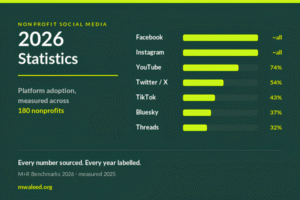
Only around 15% of nonprofits use TikTok, and the fundraising economics are poor. It can be right for some organisations. It is rarely the first thing to fix.
Working out what is right for your organisation
If you are comparing options right now, the most useful thing you can do is not read more pricing articles. It is to look honestly at three things: how much content you actually need each month, what photos and video you already have, and how much of your team's time is realistically available for approvals and input.
Those three answers set your budget more accurately than any benchmark.
You can also read more about how I structure social media management for nonprofits, or start with social media strategy for small nonprofits if you are still working out your approach.
Want a second opinion on where you stand?
I put together a free one-page review of any nonprofit's Instagram and Facebook — posting consistency, video gaps, channel overlap, and the three things I would change first. No call required and no charge.
Get your free one-page auditHow much does social media management cost for a nonprofit in 2026?
Most US nonprofits pay $500-$2,500 per month. Small organizations typically pay $750-$1,500. Larger organizations needing video, ads and campaign support pay $2,500-$7,500+.
Is $500 a month enough for nonprofit social media?
It can be, if the scope is genuinely small around 8-12 posts a month on one or two channels, using photos you already have, with no video and limited community management. It is not enough for a full program including short-form video.
How much should a nonprofit budget for social media?
As a working rule, aim to keep the annual cost under about 1% of your total revenue. That means roughly $750-$1,200 a month for a $1M organisation, and $1,000-$1,800 for a $2-4M organisation. Overall nonprofit marketing budgets are commonly guided at 5-15% of total budget, with social media one line inside that.
Is it cheaper to hire someone or outsource?
Outsourcing at $1,200 a month costs about $14,400 a year. A half-time marketing coordinator costs roughly $34,500 once payroll taxes and benefits are included, based on average US nonprofit salary data. Hiring makes sense when you need someone present and doing more than social media. Outsourcing makes sense when you mainly need production capacity and design or video skills.