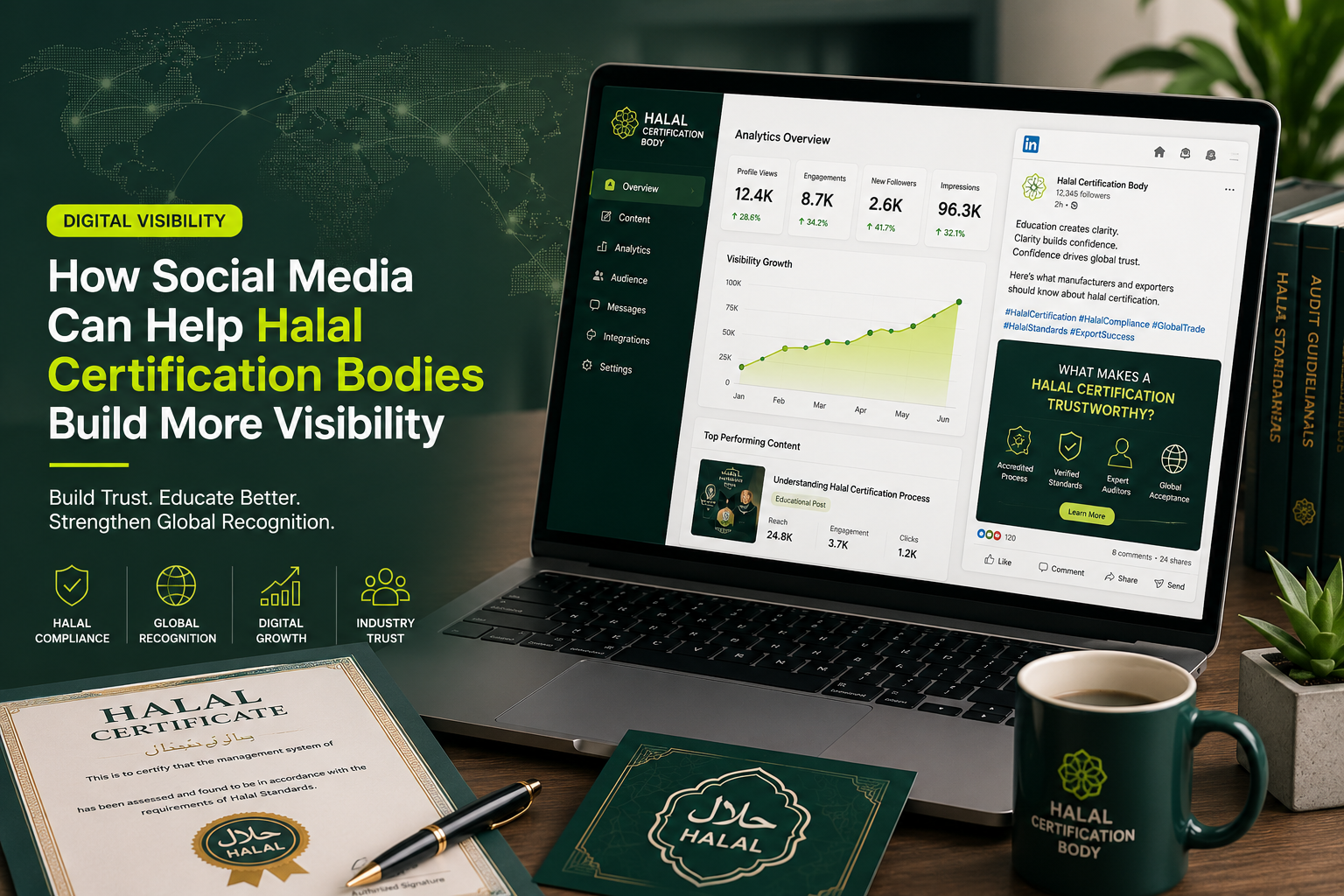
Many halal certification bodies already carry real authority in their industry.
They’ve been operating for years. They’ve built relationships with manufacturers, regulators, and exporters. Their certificates are trusted by supply chains across multiple countries.
And yet — search for them online, and you’ll often find an outdated website, a Facebook page last updated in 2021, and almost no content that explains what they actually do or why anyone should trust them.
That gap between offline credibility and online invisibility is the real problem facing halal certification bodies today.
In 2026, buyers research before they reach out. Exporters check your digital presence before submitting an application. Food brands look for signals of legitimacy before deciding which halal certification body to approach.
If your online presence doesn’t reflect your actual credibility, you’re losing business to competitors who look more visible — even if they’re less qualified.
This article is about fixing that.
Why Online Visibility Matters for Halal Certification Bodies
The Buyer Has Already Done Their Research
By the time a food manufacturer or exporter contacts a halal certification body, they’ve usually already made an initial shortlist. They’ve searched online. They’ve looked at websites. They’ve scrolled through LinkedIn pages and checked whether the certification body has any real presence in the space.
If your organization doesn’t appear — or appears with thin, outdated content — you’ve already lost ground before the first conversation even starts.
This is especially true for exporters targeting new markets. A Malaysian exporter entering the Middle East, or a European food brand trying to access Southeast Asia, is looking for signals of legitimacy. They want to know: Is this certification body recognized? Do they understand my market? Are they credible?
Social media is often the fastest place those signals are found — and most halal certification bodies are leaving that space completely empty.
Halal Certification Is a Trust Industry
Unlike most industries, halal certification lives and dies on trust.
The certificate your body issues represents a religious and regulatory commitment. Manufacturers attach your name to their products. Retailers display your logo on shelves. Regulators reference your accreditation when approving imports.
Trust isn’t optional — it’s the entire value proposition. And trust, in 2026, is increasingly built online before it is built in person.
Where Most Halal Certification Bodies Fall Short Online
They Treat Social Media Like a Notice Board
Many halal certification bodies use their LinkedIn or Facebook page like a bulletin board. Certificate announcements. A photo from a trade show. A repost from an industry association. An update every six weeks.
That is not a social media strategy. That’s a page that tells visitors very little about who you are or whether you can be trusted.
The problem isn’t the frequency. It’s the intent. A notice board communicates activities. What certification bodies actually need to communicate is expertise, credibility, and relevance.
They Don’t Explain What They Do — At All
Go to the LinkedIn pages of most halal certification bodies. Their content rarely explains the certification process, the standards they apply, the markets their certificates are accepted in, or what makes one body different from another.
From the outside, they all look the same. That’s a significant problem when a potential applicant is choosing between three different bodies and your content gives them nothing to differentiate you.
They Ignore the Questions Their Applicants Are Actually Asking
What do food manufacturers want to know before approaching a certification body?
- How long does the certification process take?
- What documentation is required?
- Is this certificate accepted in my target market?
- What’s the difference between JAKIM and MUI standards?
- What happens if an ingredient in my product is uncertain?
These are real questions being typed into search engines and asked to AI assistants right now. And most certification bodies have never answered them publicly — not on their website, not on social media, not anywhere.
What Social Media Can Actually Do for Halal Certification Bodies
Build Institutional Credibility Over Time
Social media — particularly LinkedIn — is one of the most effective platforms for building what could be called institutional credibility: the sense that an organization is serious, knowledgeable, and active in its field.
When a manufacturer searches for a certification body and finds a LinkedIn page with thoughtful content about halal standards, market updates, and certification guidance — that page communicates something a directory listing never could: these people know what they’re doing.
High-Value Content Ideas for LinkedIn
- Explanations of halal standards and what they require
- Comparisons of different market requirements (Gulf vs. Southeast Asia vs. EU)
- Updates on regulatory changes affecting halal exports
- Case studies showing the certification journey
- Commentary on industry news and trade developments
Make the Invisible Process Visible
One of the most underestimated content opportunities for halal certification bodies is simply explaining what happens behind the scenes.
The halal certification process involves ingredient audits, supply chain checks, production facility inspections, logo approvals, and ongoing compliance monitoring. Most manufacturers have no idea how thorough this is — until they go through it.
Content that explains this process in plain language does several things at once:
- It educates potential applicants before they reach out
- It demonstrates the rigor of your standards
- It builds confidence that your certificate actually means something
- It answers the real question: Why should I pay for this?
Reach Exporters at the Moment They’re Searching
Halal certification isn’t a product someone buys on impulse. It’s a considered decision, often triggered by a specific event — a new market opportunity, a regulatory requirement, an expansion into a Muslim-majority country.
At that moment of decision, the exporter starts searching. Social media content on LinkedIn is indexed. It appears in results. It gets shared within industry networks. A well-written post about “what halal certification is required to export to Saudi Arabia” can reach exactly the right person at exactly the right time.
Establish Thought Leadership in the Halal Industry
The halal industry is growing fast. New markets. New standards. New regulatory requirements. New trade agreements that affect which certificates are accepted where.
This creates a constant demand for informed, reliable commentary — and almost no halal certification body is filling that space.
A halal certification director sharing observations about evolving Gulf Cooperation Council standards has more credibility than any marketing copy. That kind of content builds authority in ways that advertising simply cannot.
The Right Platforms for Halal Certification Bodies
LinkedIn: The Primary Platform
LinkedIn is where this audience lives. Food industry procurement managers, export compliance officers, halal product development teams, regulatory affairs professionals — these are LinkedIn users. They scroll. They read. They share content within their networks.
For halal certification bodies, LinkedIn should be the primary platform. Not because it has the most users, but because it has the right users.
YouTube and Video: Underused and High-Value
Almost no halal certification body has a meaningful video presence. That’s an opportunity.
A ten-minute video explaining the audit process, walking through a production facility inspection, or answering common applicant questions could reach thousands of views over time — and creates a level of transparency that is very difficult to match with text alone.
Facebook: Still Relevant for Certain Markets
In Southeast Asia and parts of the Middle East, Facebook remains a primary business communication channel. For certification bodies operating in or targeting these regions, Facebook is still worth maintaining — particularly for community engagement, announcements, and regional industry groups.
Content Strategy: What to Actually Post
Educational Content That Answers Real Questions
The most effective content for halal certification bodies answers the questions their applicants are already asking — in plain language, before any direct contact is made.
Examples of High-Value Educational Posts
- A breakdown of what JAKIM certification requires vs. what MUI requires
- An explanation of what makes an ingredient halal-doubtful (mashbooh)
- A guide to what documentation is needed to begin the certification process
- An explanation of which halal logos are recognized in which markets
- The difference between halal certification and halal accreditation
Market Insight Content
Exporters and manufacturers want to know what’s changing in the markets they’re targeting. A certification body that publishes regular observations about regulatory changes or shifts in consumer demand becomes a valuable resource — not just a service provider.
This is the difference between being a vendor and being a partner.
Transparency Content
What actually happens during a facility audit? What does the inspector look for? How are borderline ingredients evaluated?
Publishing this information thoughtfully builds enormous credibility. Transparency doesn’t mean giving away proprietary processes — it means showing that your process is rigorous, fair, and grounded in genuine halal standards. That’s exactly what manufacturers need to know before trusting your certificate with their product.
Common Mistakes to Avoid
Focusing on the Organization Instead of the Audience
A lot of certification body content is internally focused: We attended this conference. We issued our 5,000th certificate. We welcome our new team member.
This means very little to an exporter trying to figure out whether to trust your certification. Stop talking about yourself and start talking about things useful to your audience. The trust follows naturally.
Ignoring Comments and Questions
Social media is not a broadcast channel. When someone comments with a genuine question, leaving it unanswered is damaging — more damaging than posting nothing at all. Responsiveness on social media is itself a credibility signal.
Treating Every Platform the Same
A post that works on LinkedIn does not work on Facebook. Content simply copied across platforms without adaptation signals that no one is really thinking about the strategy — and it performs significantly worse.
How Social Media Feeds Into Broader Digital Visibility
Social media doesn’t work in isolation. It connects to and amplifies everything else in a certification body’s digital presence. A strong LinkedIn post drives traffic to a website article. An educational video gets embedded in an email newsletter. A post explaining halal standards reaches a new audience through industry group shares.
Over time, consistent social media activity builds a searchable, shareable body of content that represents your organization’s expertise online.
In AI search environments — which now surface structured, quotable content from credible sources — this kind of content becomes especially valuable. An AI assistant asked “which halal certification body covers Gulf exports?” is more likely to reference an organization with clear, authoritative content addressing that question directly.
This is the intersection of social media strategy and Generative Engine Optimization (GEO) — making your content findable not just by human search, but by AI-generated answers.
A Final Observation
The halal certification industry is built on credibility. The certificate only has value because the body behind it is trusted.
In an increasingly digital world, that trust needs to exist online — not just in industry relationships and physical offices.
Social media, done with intention and industry awareness, is one of the most practical ways to build that digital credibility. It doesn’t require a large team or a large budget. It requires knowing what your audience needs to understand, and being willing to explain it clearly.
The certification bodies that start building their online presence now will look — and be — significantly more visible in two years than those who wait.
Ready to Build a Stronger Digital Presence?
I work with halal certification bodies on content strategy and social media — helping them communicate their credibility online in ways that reach exporters, manufacturers, and decision-makers.
Book a Free Discovery Call Or email directly at hello@mwaleed.orgFrequently Asked Questions
Common questions from halal certification bodies exploring digital visibility
Why do halal certification bodies need social media in 2026?
Because the buyers they serve — exporters, food manufacturers, and product developers — research online before making contact. A halal certification body with no meaningful social media presence is invisible to a significant portion of its potential applicants. Social media is now a primary trust signal in B2B decisions, including in the halal industry.
What is the best social media platform for halal certification bodies?
LinkedIn is the most valuable platform for halal certification bodies in most markets. Their primary audience — compliance officers, procurement managers, and export teams — uses LinkedIn professionally. In Southeast Asian markets, Facebook also carries significant weight. YouTube is underutilized but highly effective for educational video content about the certification process.
What kind of content should a halal certification body post on social media?
The most effective content directly answers questions that potential applicants have — about the certification process, required documentation, market acceptance of certificates, and differences between halal standards in different countries. Thought leadership content about regulatory changes and industry developments also builds significant credibility over time.
Can social media help a halal certification body appear in AI search results?
Yes. In 2026, AI-powered search tools draw on publicly accessible, authoritative content when generating answers. Halal certification bodies that publish clear, structured, expert-level content increase their likelihood of being referenced in AI-generated answers about halal standards, certification requirements, and market-specific compliance.
How does social media build trust for halal certification bodies?
Trust in halal certification comes from demonstrating rigorous standards, transparency, and expertise. Social media allows certification bodies to show — not just claim — all three. Educational content explains the process. Regulatory commentary demonstrates knowledge. Consistent, professional presence signals institutional stability. Together, these build the kind of online credibility that supports offline trust.
What makes halal certification social media different from general marketing?
Halal certification operates in a trust-sensitive industry where the audience is technical and skeptical of generic marketing. Content needs to be industry-specific, standards-aware, and genuinely useful to compliance and export professionals — not promotional in the traditional sense.
How long does it take to see results from social media for a halal certification body?
Social media is a credibility system, not a quick fix. Most certification bodies begin seeing meaningful improvements in visibility and inbound inquiries within 3 to 6 months of consistent, intentional content. The compounding effect becomes more significant over 12 to 18 months as a searchable body of expert content builds up.