If you’ve ever searched this question, you’ve probably closed the tab feeling worse than when you started.
One article tells you to post three times a day.
Another says once a week is fine.
A “guru” insists the algorithm will punish you if you slow down.
Meanwhile, you’re a nonprofit with limited staff, limited time, and an actual mission to run.
This article is here to end the confusion.
Not with trends.
Not with hustle culture.
But with realistic guidance based on how nonprofit social media marketing actually works in the real world.
Why Posting Frequency Is So Confusing for Nonprofits
Conflicting advice isn’t built for you
Most posting advice online is written for:
Businesses selling products
Creators chasing reach
Brands with content teams
Nonprofits are none of those things.
When a business posts more, it often sells more.
When a nonprofit posts more, it often just gets more tired.
The goals are different. The resources are different. The pressure is different.
Algorithm myths create unnecessary guilt
You’ve probably heard things like:
“The algorithm rewards daily posting”
“If you stop posting, your reach dies”
“Consistency means posting every day”
In practice, for nonprofits, these ideas are exaggerated.
Algorithms care about response, not volume.
If your posts are rushed, repetitive, or forced, posting more usually hurts performance instead of helping it.
Nonprofits operate on trust, not frequency
Businesses can afford to be noisy.
Nonprofits rely on credibility.
Posting too often with low-value content can quietly erode trust. Supporters may not unfollow, but they stop paying attention. That’s harder to fix.
Guilt-driven posting culture makes it worse
Many nonprofit teams post because they feel they “should,” not because they have something meaningful to share.
That mindset leads to:
Filler content
Last-minute posting
Burnout
Long gaps followed by bursts of activity
None of that builds a strong presence.
Why "Just Post More" Is Usually Bad Advice
I’ve seen this pattern repeatedly while working in social media management for nonprofits. For a small nonprofit, “post more” is one of the most destructive pieces of advice you can follow. It’s a short-term tactic that causes long-term damage.
It Causes Burnout: When a small team tries to post daily across multiple platforms without a system, exhaustion is inevitable. The social media manager (who is often also the founder or communications director) becomes a content machine, and the quality of the work suffers.
It Leads to Inconsistency: The “post more” approach is unsustainable. You might keep up the pace for a few weeks, but when a grant deadline looms or a program demands your attention, social media goes silent. This hot-and-cold presence is jarring for your audience and erodes trust. Disappearing is worse than posting less frequently.
Quality Plummets: No one has an endless supply of high-quality, mission-focused stories. A high-frequency schedule forces you to post filler content. Your feed becomes a mix of generic awareness day posts, desperate pleas for engagement, and low-impact photos. Quality, not quantity, is what makes people care.
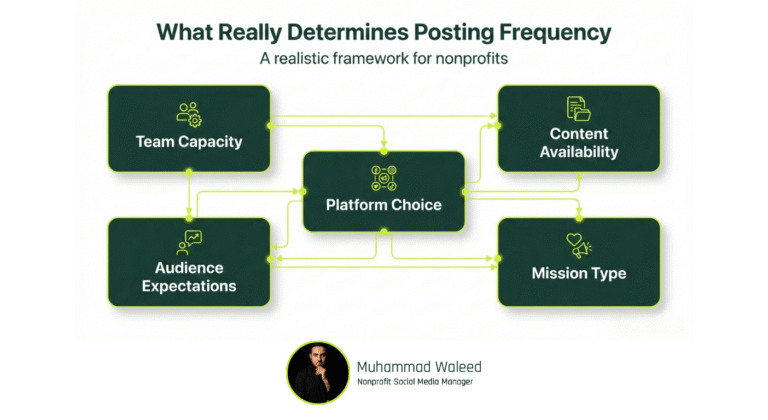
What Actually Determines Posting Frequency for Nonprofits
There is no universal “right number.”
But there is a clear framework that works.
1. Team capacity (not ambition)
The most important question is not “How often should we post?”
It’s “How often can we post without stress?”
Capacity includes:
Who creates content
Who approves it
Who responds to comments and messages
If one person handles social media alongside three other roles, daily posting is unrealistic.
2. Content availability
Nonprofits often underestimate how much content they truly have.
Posting more doesn’t create stories.
Stories come from programs, people, outcomes, and moments.
If you’re forcing posts because nothing new is happening, frequency is too high.
3. Platform choice
Each platform rewards different behavior.
Facebook tolerates lower frequency.
Instagram rewards consistency, not volume.
LinkedIn values thoughtfulness over speed.
Posting the same amount everywhere rarely works.
4. Audience expectations
Your supporters are not waiting for daily updates.
They want:
Clarity
Relevance
Meaning
For many nonprofits, fewer posts with clearer messages perform better than constant updates.
5. Mission type and sensitivity
Some causes require care.
Health, humanitarian, advocacy, and faith-based nonprofits often need more intentional pacing. Overposting can feel intrusive or overwhelming.
Recommended Posting Frequency (Realistic Ranges)
These are not rules.
They are sustainable ranges based on what actually works.
2–4 posts per week
Why this works:
Facebook favors meaningful engagement
Older posts can still perform
Your audience likely checks in occasionally, not daily
For most nonprofits, Facebook is about presence and trust, not constant visibility.
2–3 posts per week (plus optional Stories)
Why this works:
Feed posts build credibility
Stories allow lighter updates without pressure
Consistency matters more than volume
If Stories feel like extra work, skip them. A calm feed beats forced daily updates.
1–3 posts per week
Why this works:
LinkedIn rewards relevance and insight
Nonprofit leadership, impact, and learning perform well
Overposting often reduces reach
One strong post per week is enough for many nonprofits.
TikTok (optional, with caution)
Only if you have capacity
TikTok demands:
Frequent posting
Video comfort
Trend awareness
For most small nonprofits, this is not a priority channel unless video is already part of your culture.
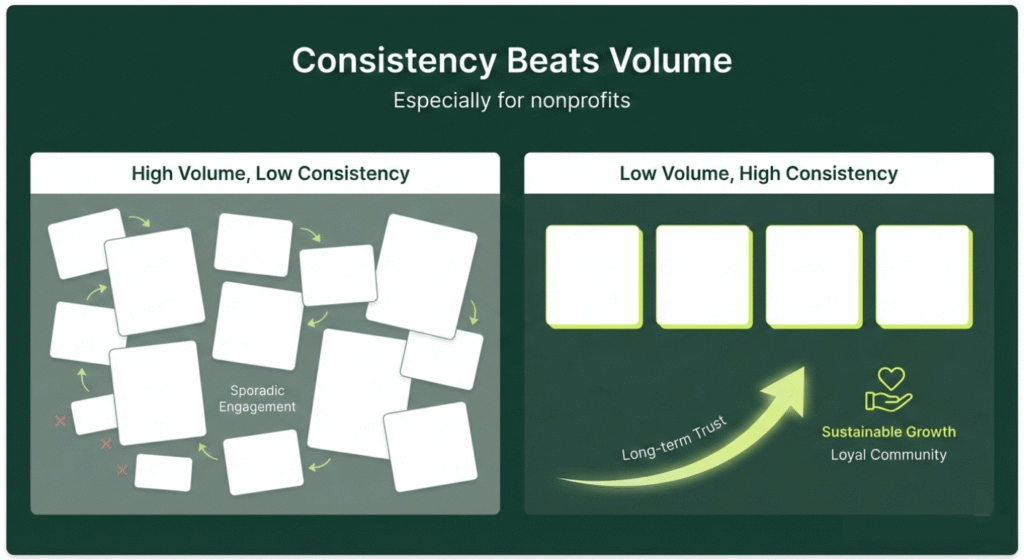
Consistency vs Volume (This Matters More Than You Think)
Why 2–3 posts per week often beat daily posting
Consistency tells your audience:
You are active
You are reliable
You respect their attention
Daily posting that disappears after a month tells a different story.
Why disappearing hurts more than posting less
When an account goes silent, supporters wonder:
Is the organization struggling?
Are programs paused?
Is anyone managing this?
A steady, lower rhythm avoids these doubts.
How consistency builds trust in nonprofits
Trust grows through:
Familiar voices
Clear messages
Repeated values
You don’t need volume to do that. You need presence.
Sample Posting Schedules (Based on Reality)
Forget complex content calendars. Let’s talk about logic.
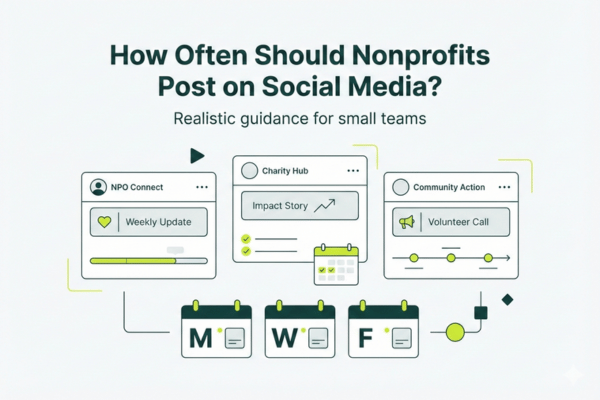
The Tiny Team (1 person, a few hours/week):
Focus: One primary platform (likely Facebook or Instagram).
Schedule: Post 2 high-quality pieces of content per week. For example, a Tuesday post sharing a success story and a Thursday post about an upcoming need or event. That’s it. That’s the system.
The Small Team (dedicated part-time role):
Focus: Two platforms (e.g., Facebook and Instagram).
Schedule: Post 3-4 times per week on the primary platform and 2-3 times on the secondary one. This allows for cross-posting where appropriate but also platform-specific content like Instagram Stories.
The Growing Nonprofit (full-time communications role):
Focus: 2-3 platforms with a clear strategy for each.
Schedule: Can comfortably manage posting 4-5 times per week on primary channels and 2-3 times on others, like LinkedIn. There is enough capacity to create a mix of content (video, graphics, stories) and engage with the community.
Frequency Is Just One Piece of the Puzzle
Ultimately, how often you post is meaningless if it isn’t part of a larger plan. Your posting frequency must serve your goals, and your goals must be defined in your strategy. This is where many nonprofits falter—by focusing on tactics before strategy.
A truly effective approach to nonprofit social media marketing requires a clear understanding of your purpose. Before you worry more about frequency, make sure you have read The Complete Guide to Nonprofit Social Media Marketing. A sustainable posting schedule is the outcome of a well-defined plan, as outlined in the Social Media Strategy for Small Nonprofits (Step-by-Step) guide.
If you’ve gone through this article and realized that your true barrier isn’t a lack of knowledge but a severe lack of time and capacity, that is a valuable insight. It may be a sign that your organization could benefit from the support of a professional nonprofit social media manager who can build and run these sustainable systems for you.
FAQs
How often should a small nonprofit post on social media?
Most small nonprofits do best with 2–3 posts per week per platform. This frequency is usually sustainable for small teams and consistent enough to maintain visibility and trust. Posting more often rarely improves results if it leads to rushed or low-quality content.
Is it bad if our nonprofit doesn’t post every day?
No. Daily posting is not required for nonprofit social media marketing. In many cases, daily posting creates burnout and inconsistency. A steady, realistic rhythm is far more effective than short bursts of high activity followed by long gaps.
Which social media platform should nonprofits prioritize?
That depends on where your audience already pays attention. For many nonprofits:
Facebook works well for community updates and trust-building
Instagram supports storytelling and visual impact
LinkedIn is useful for thought leadership, partnerships, and credibility
It’s better to manage one or two platforms well than to spread yourself thin across all of them.
Does posting more help with social media algorithms?
Algorithms respond to engagement and relevance, not just frequency. Posting more often with weaker content can actually reduce reach over time. Quality and consistency matter more than volume.
Should nonprofits post the same frequency on every platform?
No. Each platform behaves differently, and your audience uses them differently. For example, LinkedIn typically requires fewer posts than Instagram. Effective social media management for nonprofits adapts frequency based on platform expectations and team capacity.