You run a city food pantry. Last month one Facebook post went “viral” — 120k impressions, dozens of shares, and a few dozen signups. Your board celebrates. Next week, the pantry still struggles to fill weekend volunteer slots and your monthly donors are flat. Meanwhile your steady monthly newsletter, started from a handful of meaningful conversations after in-person events, brings repeat volunteers and three recurring donors.
A strong social media strategy for nonprofits isn’t about chasing the biggest numbers — it’s about choosing the metrics that support real-world outcomes like volunteers, donors, and sustained community trust. The question isn’t “Which metric is better?” It’s “Which metric moves our mission forward right now?
The confusion around engagement and reach in nonprofit social media
Nonprofits often misunderstand metrics for two reasons:
Boards and funders reward big, easy numbers. Reach and impressions sound impressive in a one-page report.
Social platforms reward short bursts. Algorithmic boosts confound cause and effect: a viral post can raise awareness — but awareness without follow-through rarely changes outcomes.
We’ll start with clear definitions so you can measures what matters.
What Reach Actually Measures
Reach (or unique reach): the number of distinct accounts or people who saw your content.
Impressions: total views — includes repeat views by the same users.
Why it matters: reach expands the universe of people who could know about your mission. It’s first in the funnel for awareness campaigns, event promotion, or one-time appeals.
What Engagement Actually Measures
Engagement: the actions people take in response to your content — likes, comments, shares, saves, DMs, clicks, signups.
Why it matters: engagement is a proxy for interest, trust, and intent. High engagement often means the audience is moving from passive awareness to active relationship.
Why businesses and nonprofits should measure success differently
A for-profit company often optimize for scale metrics that feed revenue quickly (sales volume, conversion rate to purchase). Nonprofits are mission-driven: their “conversion” could be volunteerism, advocacy, first-time donations, or long-term retention.
Your social media strategy for nonprofits should be tied to real-world outcomes: donations, volunteer sign-ups, event attendance, and policy changes. An engaged community is more likely to take these high-value actions. A disengaged, large-reach audience is not. Chasing vanity metrics is a waste of your limited and precious resources.
Principle: pick metrics that map directly to mission outcomes (e.g., volunteer signups, returned service uses, recurring donations, policy signoffs)
The case for reach (when it matters)
Reach matters when your goal is to introduce your organization to new, relevant audiences. Typical situations:
Awareness campaigns An animal shelter launching its annual “Adopt, Don’t Shop” campaign to the broader public.
Urgent Fundraising launches A disaster relief organization launching an emergency appeal after a natural disaster. The goal is to quickly inform a wide audience of the need.
Community events that require physical attendance from a geographically broad crowd.
Advocacy moments where volume of people seeing a call-to-action (sign a petition, call a representative) moves the needle.
Practical tip: If you prioritize reach, pair it with a clear next step — an email capture, event RSVP, or volunteer sign-up. Otherwise reach will be ephemeral.
The case for engagement (when it matters more)
Engagement matters more when your goals require trust and sustained action:
Trust building: comments, DMs, and video replies are where people ask hard questions and form opinions. For example: A health-focused nonprofit sharing patient stories and answering community questions to build trust.
Donor loyalty: recurring giving comes from relationships, not one-time impressions.
Volunteer retention: volunteers who interact with staff and receive regular updates stay longer.
Long-term advocacy: engaged supporters are likelier to share messages authentically.
Practical tip: design content to create two-way conversation (questions, local stories, micro-asks) — not just broadcast.
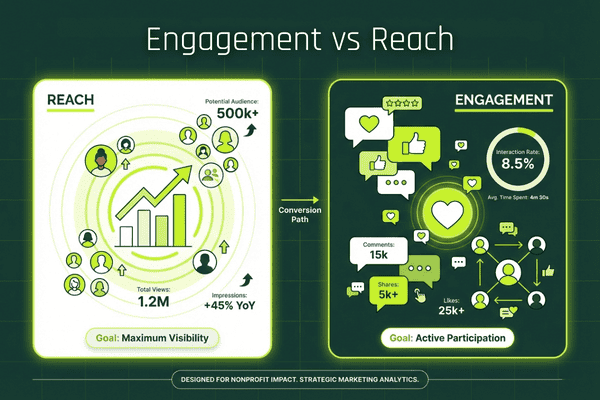
Engagement vs Reach: what actually drives nonprofit growth
Core argument: Reach introduces. Engagement sustains. Growth happens when both are intentionally connected.
Introduce → Convert → Steward is the funnel that works for mission outcomes:
Introduce (Reach): broad content, targeted paid boosts, partnerships that expose you to new audiences.
Convert (Engagement → Micro-ask): short forms, event RSVPs, volunteer sign ups, email capture with a clear follow up.
Steward (Engagement over time): onboarding sequences, volunteer check-ins, donor updates, community posts.
Framework (simple):
Reach = Top of Funnel (awareness)
Engage = Middle Funnel (interest & intent)
Convert = Action (donation, sign up)
Hold = Retention (recurring gifts, volunteers)
You don’t win by maximizing a single metric. You win by designing content and processes that move people along this flow.
A practical framework for small nonprofits
Below is a step-by-step decision guide your small team can use.
Step 0 — Start with the mission outcome
Ask: “What specific behavior solves my immediate capacity issue?” (e.g., need 20 volunteers for mobile pantry this Saturday; want 15 monthly donors.)
Step 1 — Map the required funnel
If you need volume quickly, prioritize reach paired with a micro conversion (signup page, event RSVP).
If you need sustained commitment, prioritize engagement — deeper story posts, behind-the-scenes, volunteer spotlights.
Step 2 — Choose the channel and format
Local events / volunteers: Facebook groups, local community pages, WhatsApp, SMS.
Young donor cultivation / advocacy: Instagram Reels, TikTok, short video + clear CTA.
Long-term donors: email, LinkedIn, long-form stories on your website.
Step 3 — Allocate resources (limited budget rule)
With 1 person handling social: 60% engagement, 40% reach as a starting split — unless you have an urgent launch (then flip for 2–4 weeks).
Use paid reach only when organic reach cannot get you to the right audience quickly (e.g., targeted ads for donors in neighboring districts).
Step 4 — Design content to connect the dots
Reach post → pinned CTA or limited-time form.
Engagement post → follow-up email or DM sequence.
Stewardship post → invite to closed Facebook group or volunteer briefing call.
Nonprofit engagement strategies (practical list)
Micro-asks: “Can you spare 2 hours this Saturday?” (higher conversion than “support us”).
Volunteer stories: short video interviews that highlight impact and next steps.
Behind-the-scenes reporting: one post a week showing how donations were used.
Local partnerships: co-posted content with trusted local groups extends trusted reach.
Two-way prompts: ask a single, answerable question in every post (e.g., “What’s one item your family can donate this week?”) and reply to every comment for the first hour.
Conversion focus: every reach push must include a simple, low friction next step (one-field form or calendar booking).
How This Applies to Everyday Nonprofit Social Media Marketing
In everyday nonprofit social media marketing, teams don’t have the luxury of separate awareness and engagement departments. The same person posting content is often coordinating volunteers, answering DMs, and reporting to leadership. That’s why your social media strategy for nonprofits must be simple enough to execute consistently. Prioritize repeatable systems: weekly engagement posts, monthly reach pushes tied to campaigns, and a predictable stewardship rhythm. Sustainable social media management for nonprofits is less about creativity spikes and more about disciplined execution.
Common metric mistakes nonprofits make
- Chasing viral posts as a strategy. Virality is unpredictable and not a strategy.
Reporting impressions as “engagement.” Impressions = eyes. Engagement = action. Boards need both, with outcomes.
Ignoring community signals. DMs, survey replies, and volunteer feedback are qualitative signals you can’t automate away.
Overloading reports with vanity metrics. If a metric doesn’t tie to an outcome, put it in an appendix — not the headline.
Using platform engagement as the only success measure. Social engagement is helpful, but conversions to email, volunteer slots filled, and donations closed the loop.
What nonprofit social media managers should track instead
As a nonprofit social media manager, you need a simple dashboard that connects your effort to what matters.
A Small Nonprofit Dashboard Model:
| Metric Category | What to Track | Why It Matters |
|---|---|---|
| Engagement Rate | (Likes + Comments + Shares) / Reach. | Shows the percentage of people who saw your post and cared enough to act. Aim for a rate that is average for your platform (e.g., 1-5% can be a good starting point). |
| Website Clicks | Clicks on links to your website from social media. | Measures how effectively you are moving supporters from a social platform to your owned digital home. |
| Conversion Assists | How many people from social media signed up for your newsletter, an event, or made a donation? (Tracked in Google Analytics). | This is the ultimate goal—turning social media followers into active supporters. |
| Audience Growth Rate | (New Followers / Total Followers) x 100 | Tracks the momentum of your community growth. |
FAQs
Should nonprofits focus on engagement or reach?
Focus on the metric that maps to your current mission outcome. For long-term resilience, prioritize engagement (trust and retention). For time-sensitive launches, temporarily prioritize reach but with a concrete conversion path.
What is a good engagement rate for nonprofits?
Benchmarks vary by platform and audience. Instead of chasing a single number, track your own trendline and compare similar post types month-over-month. Look for statistically meaningful improvements (e.g., consistent upward shift across 6–8 posts).
How do you increase engagement without ads?
Ask a specific question and reply to every reply for the first hour.
Use short, human stories tied to a clear small ask.
Host low-friction interactive moments (polls, live Q&A, volunteer highlights).
Encourage user-generated content with a clear hashtag and a simple incentive.
Does reach matter for fundraising?
Yes — but only when paired with a conversion mechanism. Reach sends the signal; conversion captures it. Spend to increase reach only when you have the staff and process to convert that attention.
What are the 4 types of engagement?
For nonprofit practice, use this categorization:
Reactive engagement: likes, reactions (low signal).
Conversational engagement: comments, DMs (higher signal).
Advocacy engagement: shares, personal testimonials (highest signal for reach quality).
Transactional engagement: clicks to forms, signups, donations (conversion).