Nonprofit social media marketing is one of the most misunderstood parts of nonprofit work.
I’ve seen organizations post every day for a month and disappear for the next three. I’ve seen teams burn out trying to “keep up with the algorithm.” I’ve also seen small nonprofits, with no fancy tools and no ad budget, quietly build strong online communities that support their work year after year.
The difference is not effort.
It’s clarity.
Based on managing multiple nonprofits social media accounts, I’ve seen that the “post and pray” method—where you share a graphic and hope someone cares — is the fastest way to burn out your staff. The truth is that social media for nonprofits is fundamentally different from social media for businesses. While a retail brand is trying to sell a product, you are trying to build a movement, earn trust, and inspire action.
This guide is written to give you that clarity. Not theory. Not trends. A grounded understanding of what nonprofit social media marketing actually is, how it works in the real world, and where it usually breaks down.
If you read this fully, you should not need to search elsewhere for the fundamentals.
What Nonprofit Social Media Marketing Really Means
When most people think of social media marketing, they think of viral videos or high-budget ad campaigns. For a nonprofit, marketing on social media is simply the process of using digital platforms to connect your mission with the people who care about it.
It is not “just posting.” Anyone can post a photo. Marketing is the intentional choice of what to say, who to say it to, and when to say it so that it leads to a specific result. In the nonprofit world, that result might be a new volunteer signing up, a donor making a recurring gift, or a person in need finding your services.
Why It’s Not Just Posting
If you post a picture of your team at lunch without a caption or a goal, you have “posted,” but you haven’t “marketed.” Marketing requires a bridge between the content and the mission. Every piece of content should answer the question: “How does this help our cause?” If it doesn’t help people understand the problem you’re solving or the impact you’re making, it’s just noise.
How It Differs From Business Marketing
A business measures success by ROI (Return on Investment) in a very direct way. They spend $10 on an ad to sell a $20 shirt. For an NGO, the “product” is impact, which is much harder to visualize. You are selling the feeling of making a difference and the trust that your organization will use funds wisely. This means your social media needs to be much more transparent and relationship-focused than a standard business account. You aren’t just looking for customers; you are looking for partners in your mission.
That’s why nonprofit social media marketing:
Moves slower by design
Repeats key messages often
Prioritizes credibility over cleverness
Focuses on relationships, not transactions
If you try to market a nonprofit like a product, audiences feel the mismatch immediately.
The Core Components of Nonprofit Social Media Marketing: A Strategic Framework
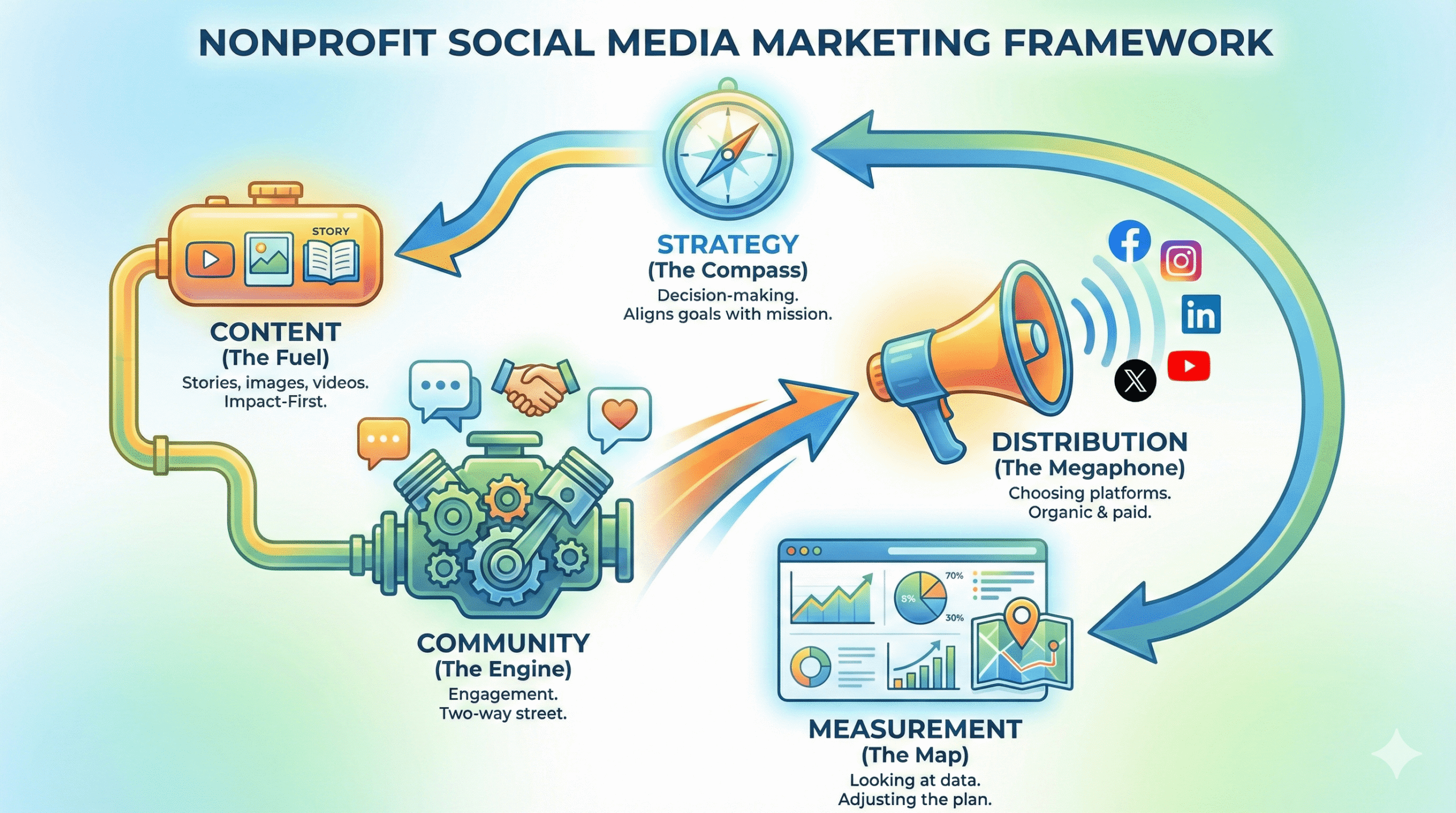
To move away from random activity, you need a framework. Based on years of strategic planning for nonprofits, I’ve found that success rests on five core components. If one is missing, the whole system feels heavy and unproductive.
1. Strategy (The Compass)
Strategy is the decision-making process that tells you what not to do. It aligns your social media goals with your organizational mission.
Example: If your nonprofit’s goal is to increase local volunteerism, your strategy would prioritize local community groups on Facebook over a global audience on LinkedIn.
2. Content (The Fuel)
This is the stories, images, and videos you share. Content must be “Impact-First.” It should either educate the audience about a problem or show the success of a solution.
Example: Instead of a generic “Please Donate” post, share a 30-second video of a beneficiary explaining how a past donation changed their life.
3. Community (The Engine)
Social media is a two-way street. Community is about engagement—responding to comments, answering messages, and facilitating conversations between your supporters.
Example: When a supporter tags their friend in your post, a simple “Thanks for sharing our mission, [Name]!” can turn a passive follower into an active advocate.
4. Distribution (The Megaphone)
Even the best content fails if no one sees it. Distribution involves choosing the right platforms and deciding when to use organic reach versus paid promotion.
Example: Repurposing a high-performing blog post into five distinct Instagram slides to ensure the message reaches people who prefer visual content.
5. Measurement (The Map)
You cannot improve what you don’t measure. This involves looking at data to see what worked and what didn’t, then adjusting your plan for the next month.
Example: Realizing that “Behind the Scenes” photos get 3x more shares than “Event Flyers,” and shifting your content plan to include more office culture.
Why Social Media Matters for Nonprofits Today
In 2026 and beyond, social media is often the first place someone encounters your organization. It has become the modern “front door.” Before a donor writes a check or a foundation approves a grant, they will likely look at your social profiles to see if you are active, transparent, and consistent.
Why Is Social Media Important for Nonprofits?
Social media is important for nonprofits because it shapes how people discover your mission, evaluate your credibility, and decide whether to support your work. For many donors, volunteers, and partners, your social media presence acts as the first impression — long before they visit your website or attend an event. It provides ongoing visibility, builds trust through consistency, and keeps your organization top-of-mind over time.
Awareness, Trust, and Long-Term Impact
Social media is the most cost-effective way to build awareness. You can reach thousands of people without the price tag of traditional mail or TV spots. However, awareness is just the beginning. The real value lies in building trust. By showing the day-to-day reality of your work, you prove that you are doing what you say you are doing. Over time, this consistent presence builds a “bank” of trust that makes fundraising much easier when the time comes.
What Social Media Can and Cannot Realistically Do
It is important to manage expectations. Social media is incredible for community building and awareness, but it is rarely a “magic button” for instant fundraising. You cannot create a Facebook page today and expect $10,000 in donations tomorrow.
Social media is a long-term play. It is a tool for nurturing relationships. Think of it as a way to keep your organization in the minds of your supporters so that when they are ready to give or volunteer, you are the first organization they think of. It cannot fix a broken fundraising strategy, but it can amplify a good one.
Strategy Comes Before Posting
The biggest mistake nonprofits make is starting with the “what” instead of the “why.” They decide they need to be on TikTok or Instagram because “everyone else is,” but they don’t have a plan for what happens once they get there.
For small nonprofits especially, strategy needs to be simple, realistic, and capacity-based. Most teams don’t fail because they lack ideas — they fail because they lack a clear strategy they can actually sustain. To solve this, I’ve created a dedicated guide on step-by-step social media strategy for small nonprofits that walks through how small nonprofits can build an effective social media strategy from scratch, without overwhelm or guesswork.
Mission-Driven Strategy vs. Random Activity
A mission-driven strategy starts with your organizational goals. If your goal for the year is to recruit 50 new mentors, your social media strategy should revolve around showing the impact of mentorship and the ease of signing up. Random activity, on the other hand, is posting a holiday greeting one day and a photo of a cat the next just because you felt like you had to post something. Random activity leads to follower fatigue and low engagement. Content planning is often where nonprofits struggle most, deserving its own strategy guide to help teams stay organized.
Short-term visibility vs long-term growth
Short-term visibility feels productive. Long-term growth actually works.
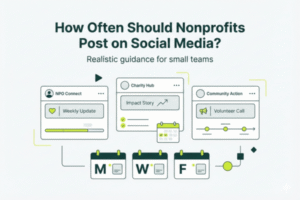
For most nonprofits, posting 2–3 times per week consistently for six months builds more trust and engagement than daily posting for three weeks followed by silence.
Consistency is not a slogan. It’s a capacity decision.
How Often Should Nonprofits Post on Social Media depends on capacity, platform, and goals — not algorithms or pressure.
Understanding Nonprofit Audiences on Social Media
You aren’t talking to one giant group of “people.” You are talking to several distinct groups, and each one needs to hear something different from you.
Donors, Supporters, Volunteers, and Beneficiaries
Donors: They want to see transparency and impact. They want to know their money is being spent wisely.
Supporters: These are people who like your cause but might not give money yet. They are your advocates; they share your posts and expand your reach.
Volunteers: They want to see the “vibe” of your organization. They want to know what it’s like to work with you and how they can help.
- Beneficiaries: These are the people you serve. They need to know how to access your services and that your organization is a safe, helpful place.
Awareness vs. Action-Stage Audiences
Someone who just followed you today is in the “Awareness” stage. They don’t know you well enough to give money yet. They need education and stories. Someone who has been following you for six months and commenting on your posts is in the “Action” stage. They are ready for a call to action. A good nonprofit strategy balances content for both groups so you are always bringing new people in while moving existing followers toward deeper involvement.
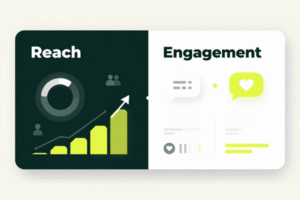
Why Trust Matters More Than Reach
In the nonprofit world, reach is a vanity metric if it isn’t backed by trust. It is better to have 500 followers who deeply trust your organization than 50,000 followers who don’t know who you are. Trust is built through consistency, being honest about challenges, and showing the real people behind the logo.
If you want a deeper breakdown of how engagement and reach affect nonprofit growth, read our full guide on Engagement vs Reach: What Matters More for Nonprofits.
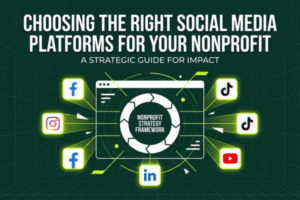
One of the fastest ways to fail at social media is trying to be everywhere at once. Most small-to-midsize nonprofits have limited staff and time. If you try to manage Facebook, Instagram, LinkedIn, TikTok, and Pinterest simultaneously, you will likely do a mediocre job on all of them.
Platform Selection Logic
Instead of chasing every platform, look at where your specific audience hangs out. Platform-specific strategies for nonprofits should be tailored to the unique culture of each site:
LinkedIn: Essential for professional donors and corporate partnerships.
Facebook: Still the leader for community events and an older donor base.
Instagram: A natural fit for missions that are highly visual (animal rescue, environmental work).
Capacity-Based Decision Making
Be honest about your team’s capacity. Do you have someone who can film and edit short-form videos three times a week? If not, TikTok might not be for you right now. In most small nonprofits, platform overload appears after 2–3 months when posting becomes inconsistent because the team is overwhelmed.
Why “Being Everywhere” Hurts Nonprofits
When you spread yourself too thin, the quality of your content drops. You start cross-posting the exact same image and caption to every platform, even though the audiences are different. This makes your organization look robotic and out of touch. It is much more effective to master one or two platforms where you can actually engage with your community.
Content That Works for Nonprofits
Content is the heart of your social media presence. For nonprofits, content shouldn’t just be “interesting”; it should be “impactful.”
Educational, Inspirational, and Impact-Focused Content
Educational: Teach your audience about the problem. People give to causes they understand.
Inspirational: Share the “wins.” Show the person who succeeded because of your program.
Impact-Focused: The data. “Thanks to your support, we served 500 meals this week.” This closes the loop for the donor.
Storytelling Without Exploitation
Storytelling is the most powerful tool a nonprofit has, but it must be done ethically. Avoid “pity marketing” or using images that strip away the dignity of the people you serve. Instead, focus on empowerment. Tell stories that show the resilience of your beneficiaries and how your organization acted as a tool they used to improve their lives.
Transparency and Credibility
In an era of skepticism, transparency is a competitive advantage. Don’t be afraid to show the “boring” parts of your work—the planning meetings, the logistics, the unboxing of supplies. This behind-the-scenes content proves that you are a real, functioning organization.
Community Building and Engagement
Social media was never meant to be a megaphone; it was meant to be a telephone. If you only post and never respond, you are missing the “social” part of social media.
Moving Beyond Likes and Shares
A “like” is the lowest form of engagement. It takes half a second. A comment or a direct message, however, is a sign of a real connection. Your goal should be to spark conversations. Ask questions in your captions. Run polls. Encourage people to share their own stories.
Two-Way Communication
When someone comments on your post, reply to them. Even a simple “Thank you for your support!” goes a long way. Community building is the work of turning a stranger into a fan and a fan into a donor.
Managing Feedback and Conversations
Not all engagement will be positive. Handling criticism with grace and facts actually increases your credibility with the rest of your audience. It shows that you are accountable and confident in your work.
Organic Growth vs. Paid Promotion
There is a common misconception that social media is “free.” While it doesn’t cost money to create an account, it costs time to create content.
What Organic Can Realistically Achieve
Organic content is your foundation. It is for your existing community. It’s how you talk to people who already follow you. Organic reach has been declining for years, making it difficult to reach new audiences without a distribution plan.
When Paid Promotion Makes Sense
Paid promotion (ads) is like putting fuel on a fire. If you have a post that is already performing well organically, putting $50 behind it to “boost” it to people who don’t follow you yet can be a very smart use of funds. Nonprofit advertising deserves a deeper look, specifically regarding how to navigate the strict rules platforms have for social causes.
Why Ads Don’t Replace Strategy
Some nonprofits think they can ignore their organic page and just run ads. This rarely works. When someone sees your ad, the first thing they often do is click on your profile. If your profile hasn’t been updated in three months, they won’t click “donate.”
Social Media Advertising for Nonprofits (High-Level)
If you do decide to venture into the world of paid ads, you need a clear goal. Advertising is not a one-size-fits-all solution.
Awareness vs. Fundraising Ads
Awareness Ads: Designed to get your name in front of people. Goals are views or website clicks.
Fundraising Ads: Designed to get a donation right now. These are much harder to get right and require a very strong “ask.”
Budget Expectations
You don’t need a million-dollar budget. Many small nonprofits see success with $5 to $10 a day. The key is to be very specific about who you are targeting. Instead of “everyone,” target “people interested in local animal shelters who live in this zip code.”
Why Many Nonprofit Ads Fail
The number one reason nonprofit ads fail is that the “ask” is too big for the relationship. Asking a total stranger for a $100 donation in an ad is like asking someone to marry you on the first date. Ads work best when they offer value first.
So common patterns include:
Asking for donations too early
Unclear messaging
No follow-up experience after the click
Advertising is part of a system, not a shortcut.

Measuring What Actually Matters
It is easy to get distracted by “vanity metrics” that look good but don’t mean anything for your mission. Nonprofit social media measurement should always link back to your bottom line.
Meaningful Metrics vs. Vanity Metrics
Vanity Metrics: Total followers, total likes, number of impressions. These tell you how many people saw your content, but not how many cared.
Meaningful Metrics: * Shares: Shows deep value and advocacy.
Click-Through Rate (CTR): How many people went to your website?
Conversion Rate: How many actually signed up or donated?
Reporting Results Simply
If you are reporting to a board, keep it simple. Instead of “10,000 impressions,” say “Our social media content drove 200 new visitors to our donation page, resulting in 5 new recurring donors.”
Using Insights to Improve Strategy
Look for patterns in your data. Do your followers respond better to videos or photos? Do they engage more in the morning or evening? Let the data guide your next month of content.
Common Social Media Mistakes Nonprofits Make
Even with the best intentions, it’s easy to fall into traps that drain your energy. Recognizing these early can save your team months of wasted effort.
Inconsistent Posting: Posting five times in one week and then disappearing for a month. Consistency builds reliability.
Platform Overload: Trying to be on 6 platforms with a team of one.
Trend-Chasing: Jumping on every meme even if it doesn’t fit your mission. If you have to explain the connection, it’s not the right trend.
Building a Sustainable Social Media System
For most nonprofits, social media is a “side job” for someone who is already busy. To make it work, you need a system, not just a list of tasks.
Small Teams and Limited Resources
You don’t need a full-time manager to start. You need a workflow.
Batching: Spend two hours on Monday creating and scheduling the entire week’s posts.
Content Pillars: Decide on 3 topics (e.g., Impact Data, Volunteer Spotlights, Educational Tips) to remove the “what do I post?” anxiety.
When Professional Support Becomes Necessary
There comes a point where a nonprofit outgrows its current capacity. You might need professional NonProfit Social Media Manager help if you notice these signals:
A growth plateau after 6–9 months, even with consistent effort
Campaigns becoming more complex and harder to coordinate
Internal burnout, turnover, or dropped responsibilities
No clear ownership, accountability, or follow-through
At this stage, external support isn’t about “doing more.” It’s about bringing structure, consistency, and strategic focus.
FAQs
What is nonprofit social media marketing?
Nonprofit social media marketing is the use of social platforms to build awareness, trust, and long-term support for a mission, not just to post updates.
How Often Should Nonprofits Post on Social Media?
Quality always beats quantity. It is better to post 3 high-quality, impactful posts per week than 7 mediocre ones. Consistency is what matters most to the algorithms.
Do nonprofits need to be on every social media platform?
No. It’s better to manage one or two platforms well than to be active everywhere and struggle to stay consistent.
Can social media really help with fundraising?
Yes, but usually indirectly. Social media builds trust and awareness first, which makes fundraising efforts more effective over time.
What metrics matter most for nonprofit social media?
Engagement quality, steady audience growth, and actions taken beyond social media matter more than likes or follower counts alone.