Many nonprofit teams feel pressure to be everywhere online.
Board members ask why you’re not on TikTok. A volunteer suggests Threads. Someone read an article about LinkedIn fundraising. Suddenly your small team is trying to manage five accounts, none of them getting real attention.
This is how burnout starts.
Social media marketing for nonprofit organization is not about presence. It’s about focus. The right platform strategy saves time, protects staff capacity, and increases real-world impact. The wrong strategy creates noise and guilt.
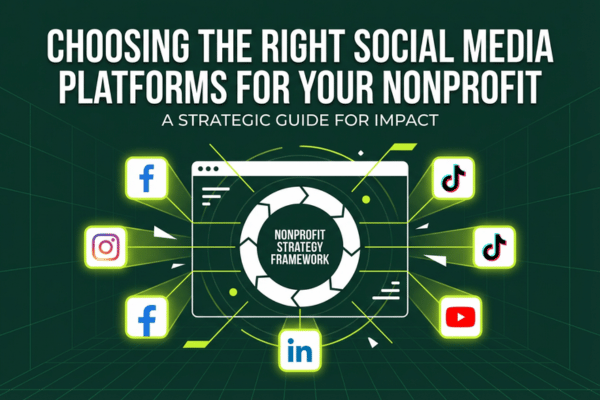
This guide is not a platform popularity contest. It’s a decision framework. By the end, you should be able to confidently choose where your organization should invest effort — and just as importantly, where you should not.
If you need a full foundation before choosing platforms, my pillar guide, The Complete Guide to Nonprofit Social Media Marketing, explains how platforms fit into the bigger system. This article focuses specifically on platform strategy.
Why Platform Choice Is a Strategic Decision — Not a Marketing Trend
Every platform demands a different type of work.
Different formats
Different posting rhythms
Different audience expectations
Different content skills
Small and mid-size nonprofits rarely fail because of bad intentions. They fail because they spread limited capacity across too many channels.
A smart social media strategy for nonprofits starts with one question:
Where can we show up consistently with the resources we actually have?
Consistency beats reach. Every time.
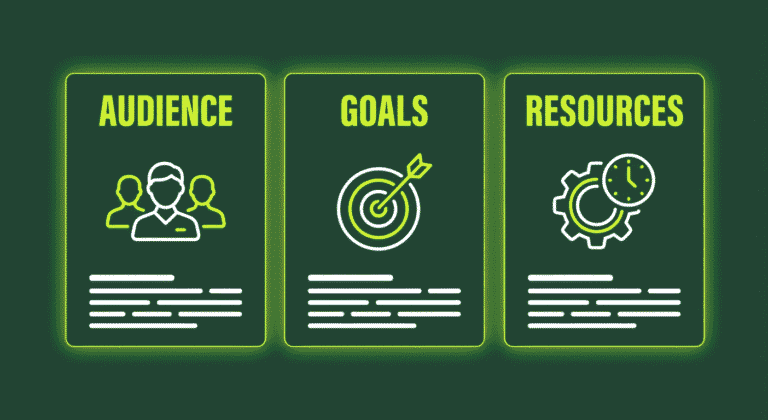
Before evaluating platforms, your team should be clear about:
Your primary goal (awareness, education, fundraising, advocacy, recruitment)
Your available staff time per week
Your content production capacity
Your audience’s digital behavior
Your tolerance for experimentation
If your strategy is unclear, platform choice becomes guesswork. That’s why platform planning should connect directly to the broader system described in Social Media Strategy for Small Nonprofits.
The Platform Decision Framework Nonprofits Should Use
Instead of asking “Which platform is best?”, ask these four questions.
1. Where does your audience already spend time?
Nonprofits don’t need to create demand. They need to meet people where they already are.
If your supporters are parents, Facebook groups may matter more than TikTok.
If you work in professional development, LinkedIn may outperform Instagram.
If you rely on storytelling, YouTube may carry more weight than text-based platforms.
Audience behavior is more important than platform trends.
2. What kind of content can you realistically produce?
Some platforms reward polished video. Others reward consistency and conversation.
If your team struggles to film video weekly, TikTok may become a burden.
If you can write strong educational posts, LinkedIn may be efficient.
If your staff captures photos from programs, Instagram may fit naturally.
Choose formats you can sustain without stress.
3. How much time can your team maintain long-term?
A platform is not a campaign. It’s an ongoing commitment.
One well-managed account is more powerful than four neglected ones.
If your capacity is limited, strong social media management for nonprofits means protecting your team from overextension, not chasing every new channel.
4. What action do you want supporters to take?
Each platform supports different behaviors:
Quick awareness
Long-form education
Community conversation
Donations
Volunteer recruitment
Your platform choice should match the behavior you want to encourage.
Platform-by-Platform Strategic Analysis
This section is not about popularity. It’s about trade-offs.
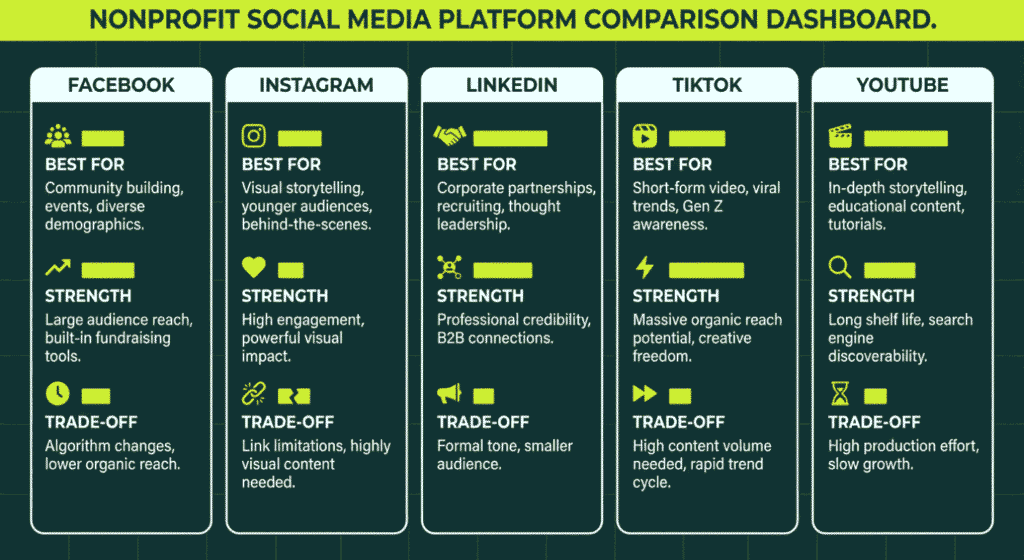
Facebook remains one of the most practical platforms for many nonprofits, especially those serving local communities.
Strengths:
Trade-offs:
Organic reach is inconsistent
Requires community engagement, not just posting
Content can disappear quickly in crowded feeds
Best for:
Community-based nonprofits, service organizations, faith groups, and advocacy campaigns that rely on conversation and events.
If your audience is over 30, ignoring Facebook is usually a mistake.
Strengths:
Trade-offs:
Best for:
Organizations with strong program visuals, youth-focused missions, or storytelling-driven fundraising.
If your team already captures photos from fieldwork, Instagram can be efficient.
It is not a donor platform first. It is a credibility platform.
Strengths:
Institutional trust
Corporate partnerships
Board recruitment
Professional visibility
Thought leadership
Trade-offs:
Best for:
Nonprofits seeking partnerships, sponsors, or professional positioning.
If your executive director writes strong insights, LinkedIn can carry authority with minimal production effort.
It rewards authenticity, speed, and experimentation.
Strengths:
Massive discovery
Youth engagement
Viral storytelling
Low production barriers
Trade-offs:
Best for:
Organizations willing to experiment and post consistently.
If your team cannot commit to weekly video, TikTok may create pressure without payoff.
YouTube functions more like a library than a feed.
It is long-term content infrastructure.
Strengths:
Evergreen education
Search visibility
Donor storytelling
Training and awareness
High credibility
Trade-offs:
Production time
Editing demands
Slower early growth
Best for:
Nonprofits that teach, explain, or document impact.
YouTube is less about frequency and more about quality.
X, Threads, and Emerging Platforms
They reward fast updates and commentary.
Strengths:
Advocacy
Policy conversations
Real-time engagement
Public dialogue
Trade-offs:
Best for:
Advocacy-driven organizations comfortable with public discourse.
For most small nonprofits, these are optional — not essential.
The “One Strong Platform” Rule for Small Teams
If your nonprofit has fewer than three staff managing communications, your default strategy should be:
One primary platform
One secondary platform
Everything else optional
Trying to master five channels rarely produces meaningful results.
Depth beats breadth.
Many nonprofits grow faster after reducing platforms, not adding them.
A nonprofit social media manager’s job is often to protect the organization from platform overload, not expand it.
When to Expand to Additional Platforms
Expansion should happen only when:
Your current platform is stable
Posting is consistent
Engagement is growing
Content production feels manageable
Your team is not burned out
Expansion is a capacity decision, not a trend decision.
Professional nonprofit social media marketing becomes valuable when internal bandwidth becomes the bottleneck — not before.
Platform Strategy Is a Capacity Strategy
The most overlooked truth in nonprofit communications:
Your strategy must match your energy.
A smaller, consistent presence builds more trust than a scattered one.
Supporters care about reliability, not platform count.
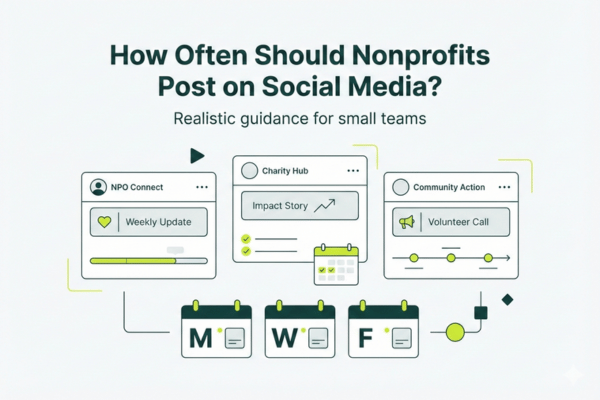
If your team struggles to maintain frequency, review our article How Often Should Nonprofits Post on Social Media? to align expectations with reality.