Food pantries don’t struggle with impact. They struggle with visibility, consistency, and engagement.
Most teams are doing important work offline while their social media stays quiet, inconsistent, or unclear. That gap directly affects donations, volunteers, and community trust.
This guide is a practical, real-world framework for building a social media marketing for food pantry system that actually works. No theory. No fluff. Just what a food pantry team can implement and sustain.
Why Social Media Matters for Food Pantries
Social media is not just about posting updates. For food pantries, it serves three critical roles:
- It shows proof of impact to donors
- It builds trust with the local community
- It creates a steady pipeline of volunteers and supporters
When done right, your social presence answers questions people don’t even ask directly:
“Is this organization active?”
“Do they actually help people?”
“Can I trust them with my donation?”
If your content doesn’t answer these clearly, people scroll past.
The Foundation: A Clear Social Media Strategy for Food Pantries
Before posting anything, you need clarity. Without it, even good content fails.
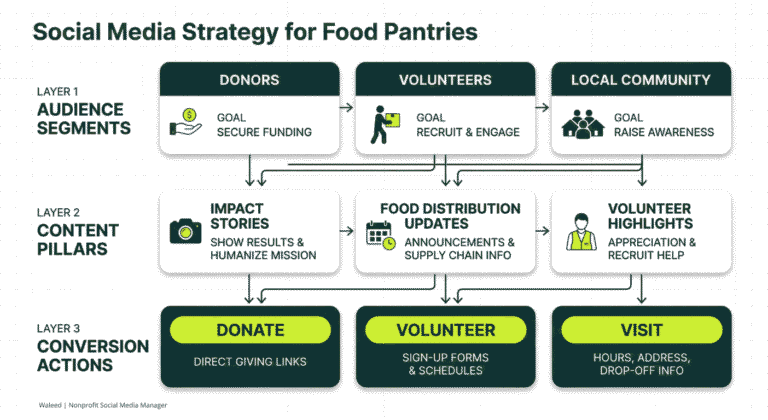
A strong social media strategy for nonprofits starts with three decisions:
1. Who Are You Talking To?
Food pantries usually serve multiple audiences:
- Donors
- Volunteers
- People in need
- Local partners
Most accounts fail because they try to speak to everyone in the same way.
Fix:
Assign content to specific audiences. Not every post needs to speak to everyone.
2. What Action Do You Want?
Every post should lead to one of these:
- Donate
- Volunteer
- Share
- Visit
- Learn
If a post has no clear action, it becomes noise.
3. What Will You Be Known For?
Pick 3–4 content themes and stay consistent.
Example:
- Food distribution updates
- Volunteer stories
- Behind-the-scenes operations
- Community impact
This creates identity. Without it, your page feels random.
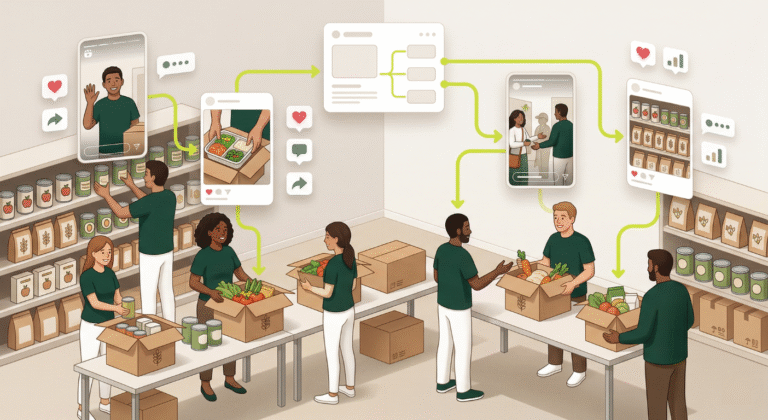
Content That Actually Works for Food Pantries
Most nonprofit content fails because it’s either too formal or too vague.
Here’s what works in real accounts.
1. Show Real Activity
People trust what they can see.
Instead of:
“We distributed food today.”
Show:
- Volunteers packing boxes
- Shelves before and after
- People (respectfully) receiving help
This builds credibility without needing big claims.
2. Tell Small Stories
You don’t need dramatic storytelling.
Simple works better.
Example:
“A volunteer came for one day… and stayed for 6 months.”
That’s enough.
3. Make Needs Clear and Specific
Avoid vague posts like:
“We need donations.”
Instead say:
“We need 200 rice bags before Friday.”
Clarity increases response.
4. Repeat Your Message (Without Repeating Content)
Your mission should appear often, but through different angles:
- A story
- A statistic
- A visual
- A volunteer quote
This is how people remember you.
Platform Strategy: Where Food Pantries Should Focus
Not every platform deserves your time.
Still the strongest platform for local nonprofits.
Use it for:
- Community updates
- Event promotion
- Donation drives
Best for visibility and storytelling.
Focus on:
- Reels showing real activity
- Carousels explaining your work
- Simple, human captions
Often ignored, but useful for:
- Partnerships
- Corporate donors
- Grant visibility
If your team is small, it’s better to do 1–2 platforms well than 4 poorly.
Posting Consistency (Without Burning Out)
Consistency is where most food pantries struggle.
Not because they don’t care. Because they don’t have time.
A Realistic Schedule
- 3 posts per week is enough
- 1 story update on active days
- 1 short video weekly
That’s sustainable.
Batch Your Content
Instead of posting daily:
- Capture photos/videos during distribution days
- Create 1–2 weeks of content in one session
This reduces stress.
Captions That Drive Action
Captions don’t need to be long. They need to be clear.
A simple structure works:
- What happened
- Why it matters
- What people can do
Example:
“We distributed 150 food boxes today.
This helps families who rely on weekly support.
If you want to help, we need volunteers this Friday.”
That’s enough.
Common Mistakes Food Pantries Make
Posting Only When They Need Something
This breaks trust.
Balance is key:
- 70% value (updates, stories, impact)
- 30% asks (donations, volunteers)
Overly Formal Language
People connect with people, not institutions.
Write like a human.
Ignoring Comments and Messages
Engagement builds relationships.
If someone comments, respond.
Trying to Look “Perfect”
Authenticity beats polish every time.
Real photos outperform designed graphics in most cases.
When to Consider Professional Help
Many food pantries reach a point where:
- Content becomes inconsistent
- Growth stalls
- The team feels overwhelmed
This is where social media management for nonprofits becomes valuable.
Not because you can’t do it internally, but because:
- Consistency requires time
- Strategy requires experience
- Execution needs structure
A nonprofit social media manager can help turn scattered efforts into a system.
Building a Sustainable System (Not Just Posting)
The goal is not more content.
The goal is a system your team can maintain.
That includes:
- Defined content themes
- Simple posting schedule
- Clear messaging
- Regular content capture
If you already have some structure in place, you can refine it further through a broader nonprofit social media marketing framework. This connects your content with fundraising, partnerships, and long-term growth.
For smaller teams, it’s also worth studying practical approaches designed specifically for limited resources, like those outlined in strategies for small nonprofit teams.
Final Thoughts
A strong social media marketing for food pantry strategy is not about being everywhere or posting daily.
It’s about:
- Showing real work
- Speaking clearly
- Staying consistent
- Making it easy for people to help
When done right, your social media becomes an extension of your mission, not an extra task.
And when your internal capacity reaches its limit, structured social media management for nonprofits can help maintain that consistency without slowing down your core work.
The goal is simple:
Make sure the impact you’re already creating is visible, understood, and supported.
What is the best social media marketing strategy for a food pantry?
The best strategy focuses on three things: showing real impact, posting consistently, and guiding people toward clear actions like donating or volunteering. Keep content simple, human, and centered around your community.
How often should a food pantry post on social media?
A realistic schedule is 3 posts per week and a few story updates during active days. Consistency matters more than frequency. It’s better to post regularly than to post daily and stop.
Which social media platform is best for food pantries?
Facebook is usually the most effective for local reach and community engagement. Instagram works well for storytelling and visibility, while LinkedIn helps with partnerships and corporate donors. Focus on 1–2 platforms instead of trying to be everywhere.
What type of content works best for food pantries?
Content that shows real activity works best. This includes food distribution moments, volunteer stories, behind-the-scenes work, and clear donation needs. People trust what they can see.