
You’re the founder of a small nonprofit, the sole communications person, or maybe a dedicated board member. You’ve been told a thousand times that you must be on social media. But every guide you read feels like it was written for a different world—a world with teams, budgets, and endless hours to create content.
You’re left feeling overwhelmed, posting sporadically, and wondering if any of it is even working. The pressure from your board to “get more followers” isn’t helping.
Let’s take a breath. I’ve worked with dozens of small nonprofits, and I know the reality of burnout and capacity limits. A successful social media presence isn’t about doing everything; it’s about doing the right things consistently.
This article is your permission to ignore the hype. It’s a step-by-step guide to building a social media strategy for nonprofits that creates real impact without demanding all your time. It’s strategy-first, not platform-first — the way effective nonprofit social media marketing actually works for small teams.
If you’re looking for a broader understanding of nonprofit social media — including platforms, content formats, and common myths — this guide builds on The Complete Guide to Nonprofit Social Media Marketing, which covers the full landscape before we zoom in here on strategy for small teams.
What “Social Media Strategy” Really Means for Small Nonprofits
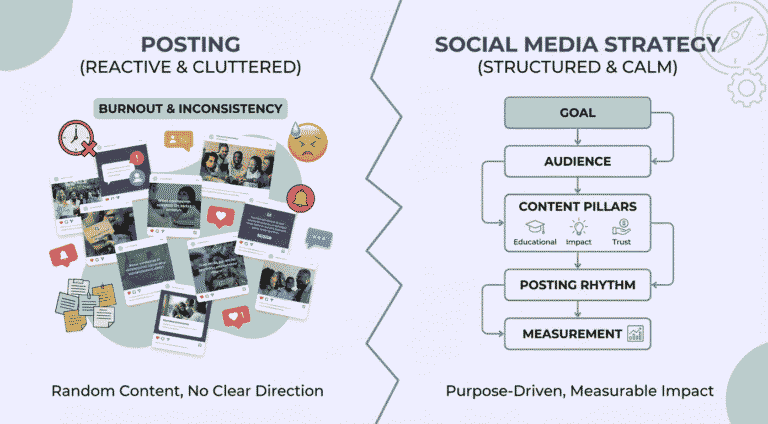
In nonprofit social media marketing, a lot of people confuse “strategy” with “posting a lot.” Strategy is the clear pattern of choices you make so every post contributes to one priority outcome.
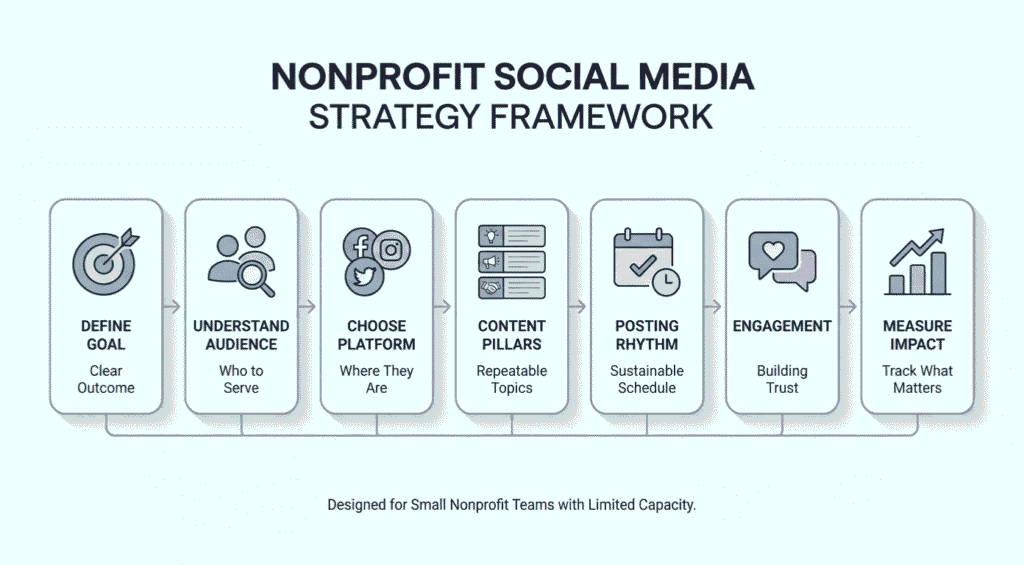
Strategy = (One primary goal) + (The audience you’ll serve) + (A small set of repeatable content types) + (A sustainable rhythm) + (a way to measure impact).
Posting without that framework is busywork. Small nonprofits need simpler, tighter strategies because they have less time, fewer approvals, and unpredictable volunteer capacity. A good strategy removes decision fatigue — you know what to post and why.
Common misconceptions
“More platforms = more impact.” Not true for small teams. It multiplies work.
“You need to go viral.” Viral is unpredictable; steady, mission-linked growth wins.
“Engagement is vanity.” Engagement only matters when it’s tied to the goal (e.g., signups, volunteers, donations).
Why Small Nonprofits Need a Different Social Media Strategy
Capacity limits. Staff wear multiple hats. Strategy must respect time constraints.
Volunteer-led teams. Volunteers come and go. The plan needs to be simple enough for different people to follow.
Founder-led accounts. Founder burnout is real. If the founder is posting, the plan must protect their time and voice.
Why copying big nonprofits fails. Large orgs have budgets for content, comms teams, and paid reach. Copying them leads to unrealistic expectations and wasted effort.
This is why a realistic social media strategy for nonprofits must be designed around capacity first — not trends, algorithms, or what large organizations are doing.
Step-by-Step Social Media Strategy for Small Nonprofits
Step 1 — Define One Clear Goal (Not Five)
Pick a single primary outcome for the next 90 days. Options might include:
Get X new monthly donors (e.g., 20 new recurring donors)
Acquire Y email addresses (e.g., 250 signups)
Recruit Z volunteers for a campaign (e.g., 30 volunteers)
Increase awareness among a specific community group (measured by growth in engaged followers from that community)
How to choose ONE goal
Ask: which outcome most directly advances mission this quarter?
Choose the one you can measure without extra systems (email signups, donation page conversions, volunteer signups).
Write a one-line goal: “Increase monthly recurring donors by 20 in Q2 by driving traffic from Instagram to a simple donation landing page.”
Example goal template
“We will [action] to increase [metric] from [current number] to [target number] by [date].”
Step 2 — Identify Your Actual Audience (Not “Everyone”)
Stop aiming at “everyone who cares.” Define 1–2 real groups that can act on your goal.
Audience short-form persona
Name: (e.g., Local Donor Mary)
Age range / profile: (e.g., 35–60, local small-business owner)
Key motivation: (e.g., wants trustworthy local impact)
Best channel/format: (e.g., Facebook posts + email follow-up)
Preferred action: (e.g., monthly giving, volunteer shift)
Triage audiences by stage
Awareness: people who need to discover you
Consideration: those weighing support
Action: donors, volunteers, signups
Tailor content to the stage you selected for your goal. For fundraising, prioritize “consideration → action.”
Step 3: Choose ONE Platform to Master First
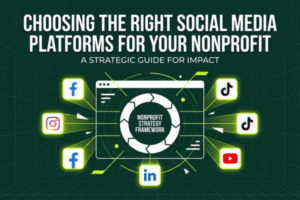
This is the most important—and freeing—step. You do not need to be on Facebook, Instagram, X (Twitter), and LinkedIn. In fact, you absolutely shouldn’t be. Choose ONE platform where your audience from Step 2 is most likely to be and commit to doing it well.
- Facebook: Still the king for reaching local communities and older demographics. Great for events, community groups, and sharing links.
- Instagram: Ideal if your work is highly visual and your audience is under 45. It’s about storytelling through images and short videos.
- LinkedIn: The right choice if your audience is composed of professionals, corporate sponsors, or foundation contacts. The tone is more formal, focused on impact, partnerships, and thought leadership.
- TikTok: Use this only if you are targeting an audience under 25 and have the capacity to create authentic, trend-driven short videos.
Example in Action:
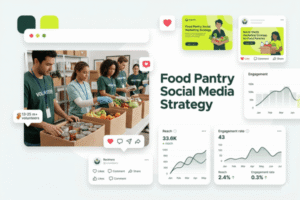
The food bank, knowing their target donor is a local community member, chooses Facebook. This is where local “what’s happening in town” conversations occur and where they can effectively share information about drop-off locations and urgent needs. They delete the dusty, unused Instagram and Twitter accounts to free up mental space.
Step 4 — Build Simple Content Pillars (3–4 Only)
Pillars make planning easy. Pick 3–4 pillars and rotate them.
Suggested pillars
Educational — short explainer about the problem and how you address it.
Impact — real stories, outcomes, quick stats.
Trust-building — behind-the-scenes, staff/board spotlights, financial transparency.
Community — volunteer features, partner shoutouts, calls to action.
How to use pillars
Create a mini-template for each pillar (format, length, CTA).
Aim to use the same 3–4 pillars for all content so your audience learns what to expect.
Example pillar template
Impact post: 1 photo, 2–3 short sentences of outcome, 1 quote, CTA → “Learn how to support” (link).
Step 5 — Create a Sustainable Posting Rhythm
Consistency is more important than frequency. A sustainable approach to social media management for nonprofits involves batching your work. Block one hour in your calendar each week to do this—and only this.
- Minutes 0-15: Plan. Open a simple document. Write down three post ideas for the coming week, one for each pillar. (e.g., Monday: Impact post about how many people you served last week. Wednesday: A photo of a volunteer. Friday: The “ask” for specific food items.)
- Minutes 15-45: Create. Write the captions for your three posts. Find the photos or use a free tool like Canva to create a simple graphic. Don’t aim for perfection; aim for authenticity.
- Minutes 45-60: Schedule. Use the free scheduling tools available within Facebook or other platforms to schedule your three posts for the week. Close the tab and don’t think about it again until your next one-hour block.
Step 6 — Engagement Is Part of the Strategy
Engagement isn’t an optional add-on — it’s the mechanism that turns followers into supporters.
Simple engagement playbook
Spend 20–30 minutes, five times a week replying to comments and DMs.
Prioritize messages from people in your audience persona (volunteer asks, donation questions).
Use a pinned post or story highlight for “How to support” so interested people find action paths quickly.
Why engagement matters more than posting
Organic reach favors posts with quick, meaningful interactions.
A thoughtful reply can convert a curious follower into a donor or volunteer.
For small organizations, engagement is often the most overlooked part of effective nonprofit social media marketing, even though it directly influences trust and action.
Step 7 — Measure What Matters (and Ignore What Doesn’t)
Likes and follower counts are vanity metrics. They feel good, but they don’t pay the bills or advance your mission. The only metric you should obsess over is the one that tracks your primary job.
- If your goal is donations, your key metric is outbound clicks to your donation page or, even better, the quantity of items donated.
- If your goal is volunteer recruitment, your key metric is clicks on the volunteer application link.
- If your goal is community engagement, your key metric is comments and shares from your target audience.
Track this one metric weekly. If it’s going up, your strategy is working. If it’s flat, you know you need to adjust your content or your “ask,” not waste time worrying about your follower count.
Common Strategy Mistakes Small Nonprofits Make
Posting without a goal. Posts should have a clear next step for the reader.
Platform overload. Spreading thin across 4–6 channels kills consistency.
Trend chasing. Trends are fine if aligned with your goal and capacity — don’t chase them for attention’s sake.
Copy-paste content. Different platforms need small tweaks. A native caption performs better than a straight cross-post.
You Can Do This
Building a social media presence as a small nonprofit isn’t about becoming a viral sensation. It’s about building trust with the right people through focused, consistent, and authentic storytelling.
You don’t need a bigger budget or a larger team to start making an impact. You just need a clear, realistic plan that respects your time and capacity. By defining your job, knowing your audience, choosing one platform, creating a simple content creation system, and measuring what matters, you will outperform organizations ten times your size that are just posting into the void.
If this strategic framework feels right, but the execution still feels like too much, this is often the point where engaging a freelance nonprofit social media manager can be a game-changer. They can take this focused strategy and run with it, giving you back your time to focus on your mission.
For a small team, aim for 1–3 quality posts per week on your primary platform plus occasional stories or short updates. Consistency matters more than daily posting.
You should expect meaningful signals in 6–12 weeks if you run a focused, measured 90-day campaign tied to one goal. Real, sustained growth typically shows in 3–6 months.
Create a 1-page monthly report with the primary metric (e.g., new donors), one short story of impact, and next steps. Keep it concrete and mission-focused.